The AI race has stopped looking like a leaderboard and started looking like a new industrial order being assembled in public. A courtroom loss for Musk becomes a compute-leverage story. Anthropic’s rise becomes a lesson in how to turn every rival cloud into a supplier. Meta’s turbulence becomes proof that money, talent, and distribution are not enough without a category-defining surface. Google’s search box becomes a command line for the internet. NVIDIA’s empire begins to feel both dominant and surrounded. And beneath all of it, coding agents, harnesses, standards, payment protocols, and verifiable trust layers reveal the deeper shift: intelligence is becoming less like software and more like infrastructure.
The Evolving AI Landscape
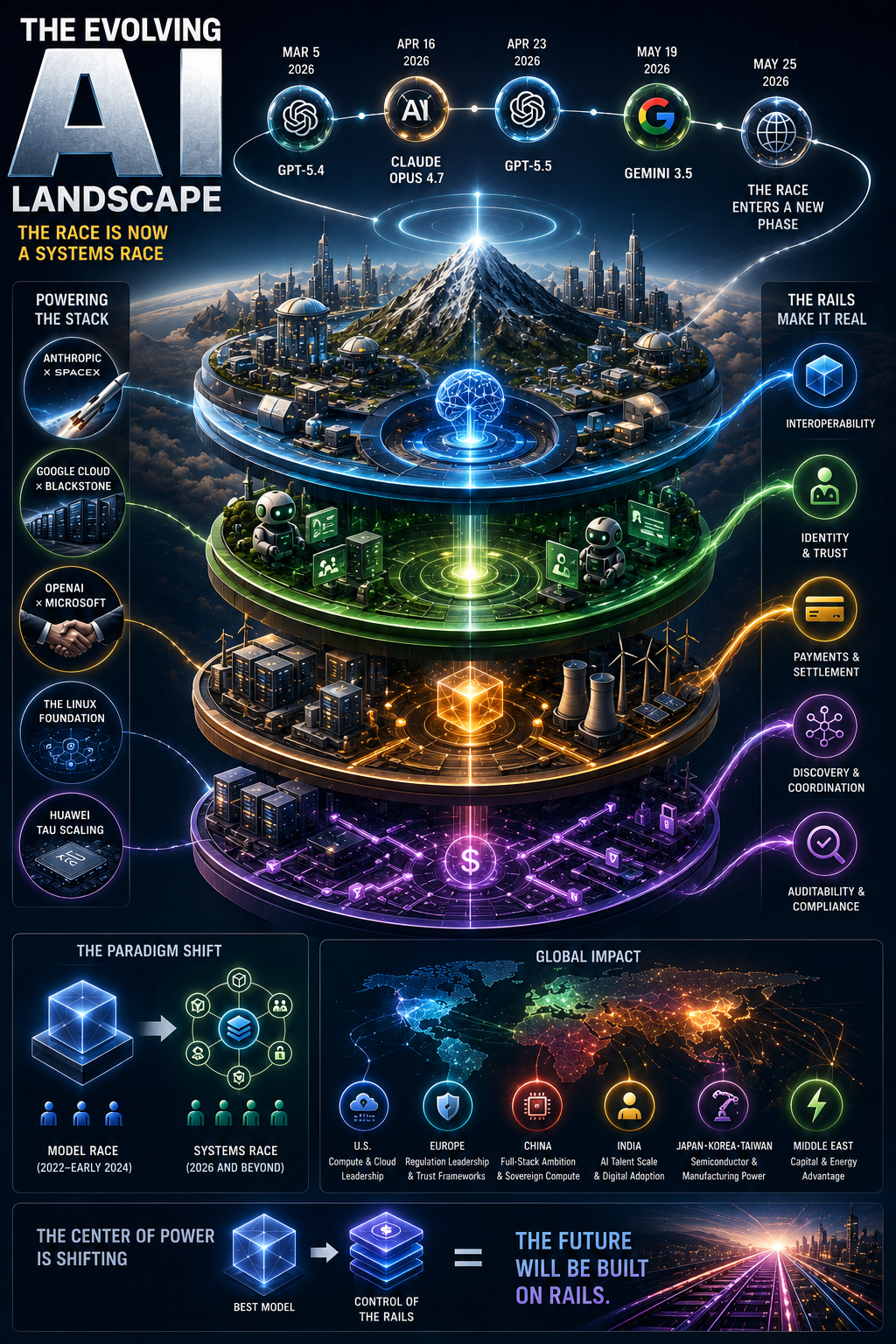
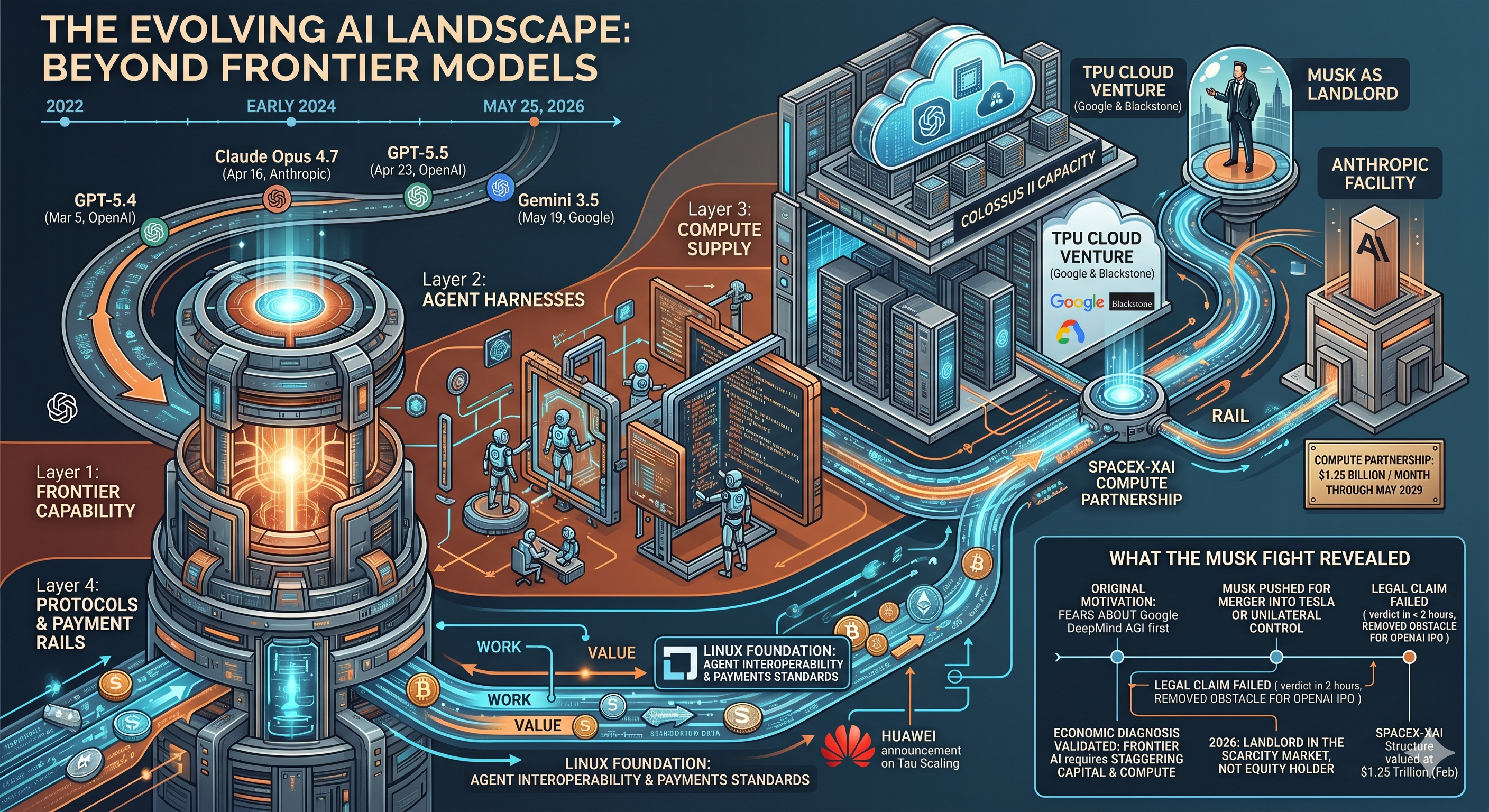
The AI race on May 25, 2026 is not the same race the world was watching in 2022 or even in early 2024. Back then, the clean question was which lab had the strongest frontier model. This spring’s release cadence still reflects that old rhythm—OpenAI shipped GPT‑5.4 on March 5, Anthropic released Claude Opus 4.7 on April 16, OpenAI answered with GPT‑5.5 on April 23, and Google rolled out Gemini 3.5 on May 19—but the real contest has widened. The fight now runs across at least four layers at once: frontier capability, agent harnesses, compute supply, and the protocols and payment rails that will let agents actually do work in the world.
That broader frame matters because many of the most consequential moves of the last few months do not look like model launches. Anthropic’s SpaceX deal, Google and Blackstone’s TPU cloud venture, OpenAI’s renegotiated Microsoft terms, the Linux Foundation’s standard-setting work around agent interoperability and payments, and even today’s Huawei announcement on “Tau Scaling” all point to the same conclusion: the center of power is moving from a single best model toward control of the rails that make advanced AI systems trainable, deployable, governable, and economically useful.
!!
What the Musk fight actually revealed
The popular shorthand for the Musk–OpenAI feud misses the most important part. The dispute was never just about wounded-founder politics. Reuters reported that both Musk and Altman testified they had originally been motivated to start OpenAI by fears about how Demis Hassabis and Google might steer the future if Google DeepMind reached AGI first. Reuters also reported in 2024 that emails released by OpenAI showed Musk had supported the creation of a for-profit entity and wanted a Tesla-linked structure that would make Tesla OpenAI’s “cash cow.” OpenAI’s own published record goes further, saying Musk pushed either for a merger into Tesla or for unilateral control, and that when those terms were rejected he left.
This month, Musk lost the lawsuit. Reuters reported on May 18 that a U.S. jury found against him, concluding that he had waited too long to sue; the verdict was reached in under two hours. Reuters then reported on May 20 that the decision removed a major obstacle to OpenAI’s expected IPO filing process. The legal claim failed, but the economic diagnosis that sat underneath many of Musk’s early arguments did not. The trial and the surrounding reporting made clear that building frontier AI at scale requires staggering capital and compute, not just technical brilliance or moral posture.
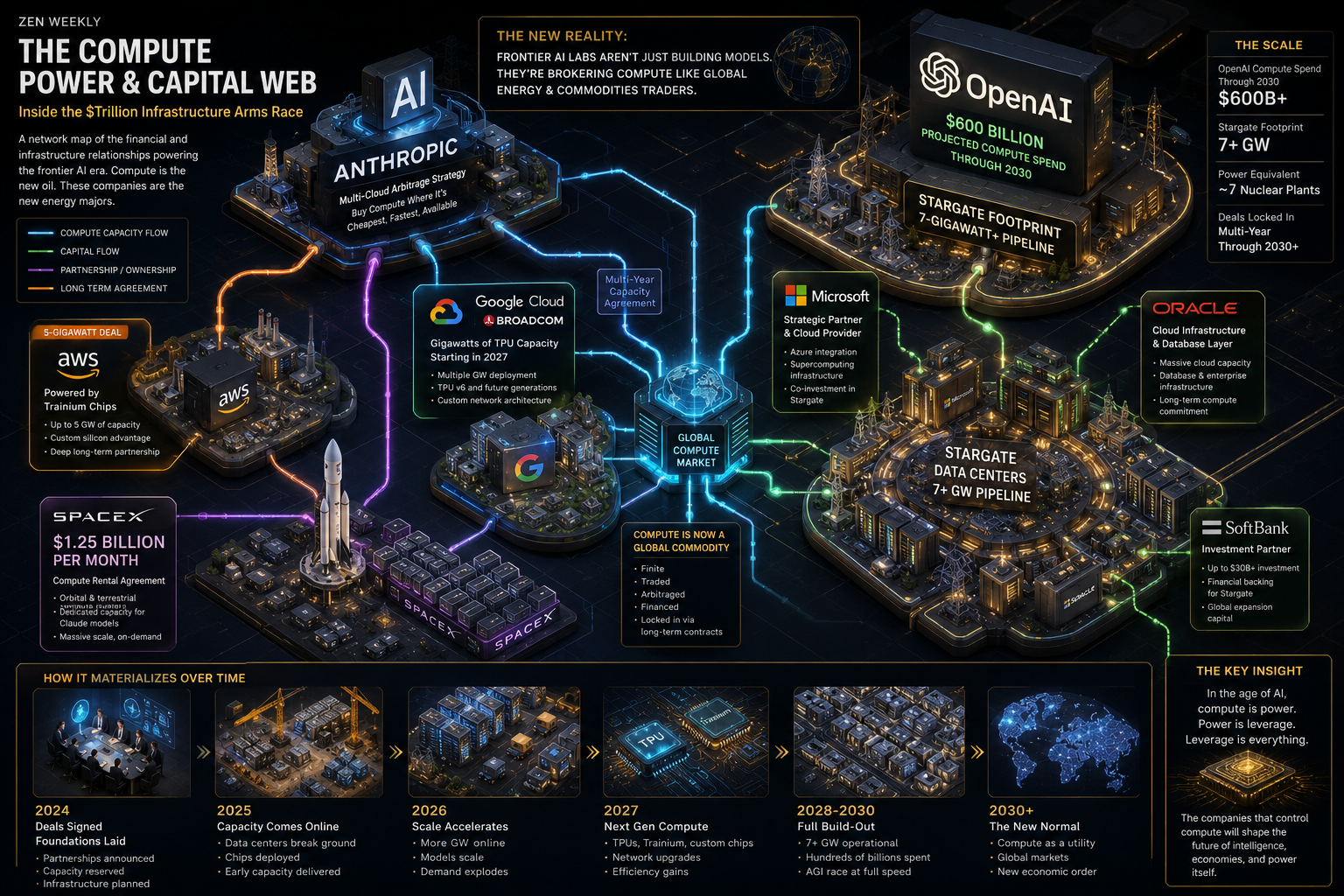
That is where the story gets genuinely strange. Musk once argued that OpenAI could not beat Google without giant compute and industrial-scale backing. In 2026, after losing that lawsuit, he now sits atop a merged SpaceX–xAI structure that Reuters says was valued at $1.25 trillion in February, and SpaceX is selling scarce compute back into the frontier-lab market. Anthropic’s May 6 announcement described its arrangement with SpaceX as a “compute partnership,” and Reuters later reported—based on SpaceX’s IPO filing—that Anthropic had agreed to pay SpaceX $1.25 billion per month through May 2029 for access to Colossus and Colossus II capacity. That is not Musk “having Anthropic.” It is something subtler and in some ways more powerful: Musk becoming a landlord in the scarcity market he once warned would decide the race.
One correction is essential here because a lot of online commentary has blurred the lines. I found no primary-source disclosure showing Musk or SpaceX as an Anthropic equity holder as of May 25, 2026. Anthropic’s Series G announcement names its investors; its SpaceX post describes a compute partnership; and Reuters’ reporting on the SpaceX contract describes a capacity-rental deal, not an ownership stake. The leverage, at least in public documents, is financial and infrastructural rather than equity-based.
!!
Anthropic became the best dealmaker in the field
Anthropic’s rise is often described as a story about safety, ex-OpenAI talent, or Claude’s strength in coding. All of that is true, but the deeper story is that Anthropic has become the most aggressive multi-cloud, multi-silicon dealmaker in frontier AI. The company said on February 12 that it raised $30 billion at a $380 billion post-money valuation. In April, Anthropic and Amazon said they had expanded their collaboration to secure up to 5 gigawatts of Amazon capacity, including nearly 1 GW of Trainium2 and Trainium3 capacity online by the end of 2026. Anthropic also said it was already using over one million Trainium2 chips to train and serve Claude, while Amazon separately described Project Rainier as one of the world’s largest AI compute clusters.
Anthropic did not stop with AWS. On April 6, the company said it had signed a new agreement with Google and Broadcom for multiple gigawatts of next-generation TPU capacity beginning in 2027. Reuters separately reported in April that Alphabet planned to invest up to $40 billion more in Anthropic, deepening a partnership that already made Google both a rival to Claude and a supplier of crucial compute. That is an awkward structure on paper, but strategically it is brilliant: Anthropic has persuaded its largest platform rivals to become its infrastructure partners and, in some cases, its investors.
Anthropic has done the same thing with Microsoft and NVIDIA. In November 2025, Anthropic said it would purchase $30 billion of Azure compute capacity and contract for up to one gigawatt more, while Microsoft and NVIDIA announced strategic partnerships around Anthropic’s growth. Reuters then reported four days ago that Anthropic is also in early talks to rent servers using Microsoft-designed AI chips. That matters because it shows Anthropic is not merely buying more compute. It is deliberately arbitraging the entire hardware landscape: NVIDIA where needed, AWS Trainium where economics work, Google TPU where scale and price-performance align, and potentially Microsoft Maia where new supply opens up.
Then came SpaceX. Anthropic said on May 6 that the new SpaceX deal would add more than 300 megawatts of power and over 220,000 NVIDIA GPUs within a month, enough to let the company immediately raise limits for Claude Code and the Claude API. Reuters reported on May 21 that the SpaceX IPO filing put the commercial terms at $1.25 billion per month through May 2029. Reuters also reported that Anthropic is nearing its first quarterly operating profit, with expected June-quarter sales above $10.9 billion and projected operating profit of $559 million. That combination—massive profit-adjacent demand and almost frantic compute procurement—is one of the clearest signs that agentic coding and enterprise workflows are now real businesses, not demos.
The less obvious implication is that Anthropic’s real product may no longer be “Claude” in the narrow chatbot sense. It increasingly looks like a full enterprise work stack: Claude models, Claude Code, managed agents, office integrations, reference architectures for finance, and a procurement machine that treats compute the way a modern airline treats fuel hedging. Anthropic’s “Agents for financial services” post described its agent templates as packages of skills, connectors, and subagents; its managed-agents documentation positions the harness itself as managed infrastructure for long-running asynchronous work. In other words, Anthropic is not only selling intelligence. It is selling a governed way to operationalize intelligence inside institutions.
Meta’s AI Paradox: Enormous Investment, Real Progress, and Still No Clear Frontier-Winning Moment
!!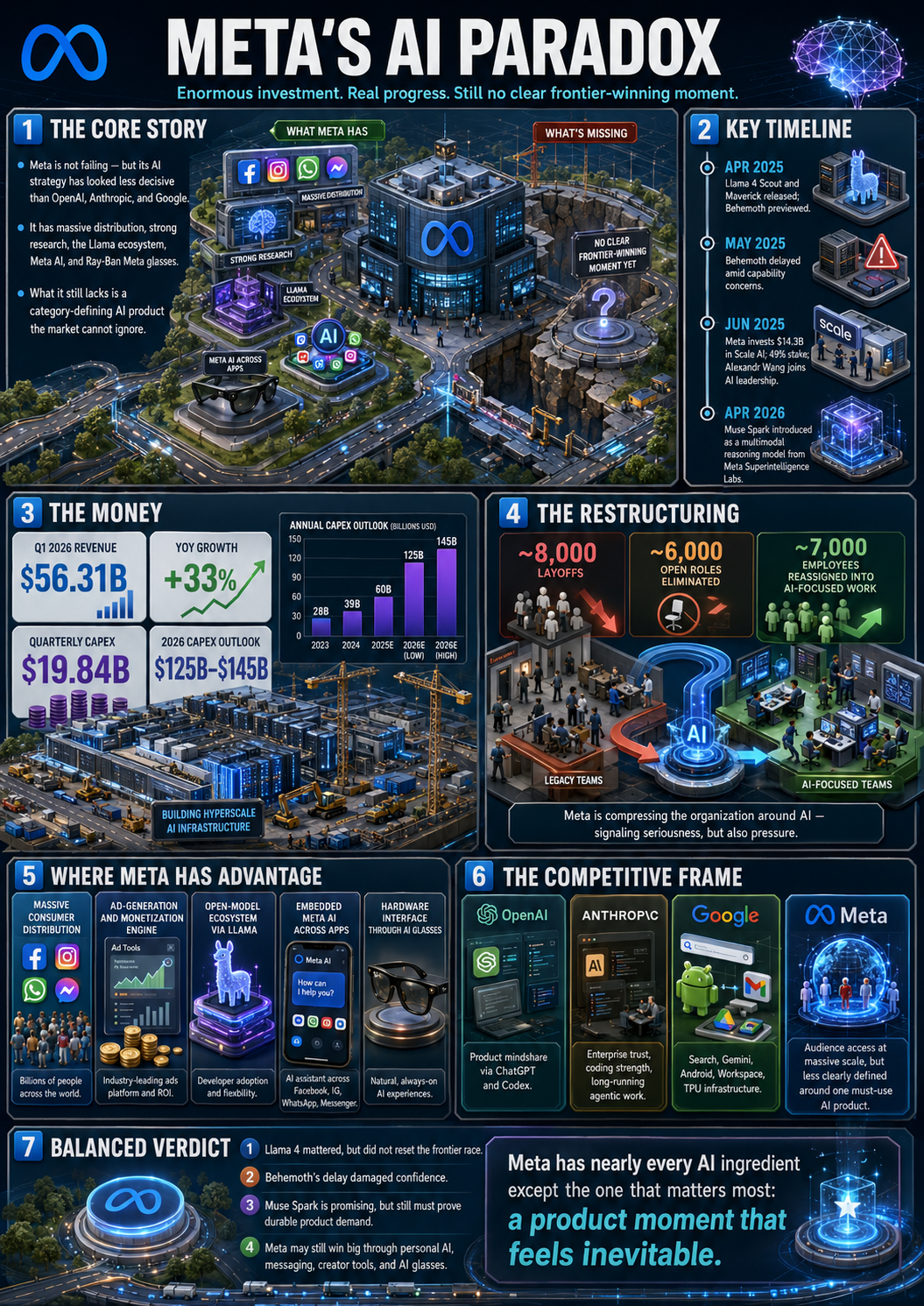
Meta has become one of the most important and complicated case studies in the AI race. It is not accurate to say the company has failed. Meta still has one of the strongest consumer-distribution networks on Earth, an enormous advertising engine, major AI research depth, the Llama open-model ecosystem, Meta AI embedded across its apps, and a growing hardware interface through Ray-Ban Meta glasses. But it is also fair to say that Meta’s AI strategy has looked less clean, less decisive, and less product-defining than the strategies of OpenAI, Anthropic, and Google over the same period.
The major pivot began in June 2025, when Meta invested $14.3 billion into Scale AI, valuing the data-labeling company at $29 billion, and brought Scale founder Alexandr Wang into Meta to help lead its artificial intelligence efforts. Reuters reported that Meta acquired a 49% stake in Scale AI, though it did not take a board seat, and that Wang would move into a major leadership role while remaining on Scale’s board. That was one of the clearest signs that Meta believed its existing AI organization needed a deeper strategic reset.
The model side has been mixed. In April 2025, Meta released Llama 4 Scout and Llama 4 Maverick, describing them as its first open-weight, natively multimodal models with mixture-of-experts architecture and very large context support. Meta also previewed Llama 4 Behemoth as its most powerful teacher model. That was a meaningful technical release, especially for the open-weight ecosystem, but it did not produce the same market shock as the strongest releases from OpenAI, Anthropic, or Google.
The most visible disappointment was Behemoth. Reuters reported in May 2025, citing The Wall Street Journal, that Meta delayed the release of Behemoth because of concerns about its capabilities. The report said engineers were struggling to improve the model enough to justify release, raising internal questions about whether its gains over prior models were significant enough. That does not mean Behemoth is worthless; it means Meta’s largest public AI bet did not land on the original timetable or with the confidence the market expected.
There have also been genuine positive developments. In April 2026, Meta introduced Muse Spark, the first model from Meta Superintelligence Labs. Meta describes it as a natively multimodal reasoning model with tool use, visual chain-of-thought, and multi-agent orchestration, designed for personal superintelligence and integrated into Meta AI across its products. That is a serious move. It shows Meta is not standing still and is shifting from open-model distribution alone toward a more product-integrated AI assistant strategy.
The business foundation remains extremely strong. Meta reported $56.31 billion in Q1 2026 revenue, up 33% year over year, with $19.84 billion in quarterly capital expenditures. The company also raised its full-year 2026 capex outlook to $125 billion to $145 billion, citing higher component pricing and additional data-center costs to support future capacity. This means Meta has both the financial capacity and the willingness to stay in the AI race at hyperscaler scale.
But that scale has come with organizational strain. Multiple reports from the last week say Meta is laying off roughly 8,000 employees, eliminating about 6,000 open roles, and reassigning about 7,000 employees into AI-focused work. The Wall Street Journal reported that the restructuring is aimed at prioritizing AI and making Meta more agile, while The Guardian reported that some internal transfers are not optional and that employees have raised concerns about workplace surveillance tied to AI-training initiatives.
This is the real Meta story: not collapse, but strategic compression. Meta is trying to fund frontier AI, rebuild internal AI leadership, absorb Scale AI talent, reorganize thousands of workers, release new multimodal models, keep the Llama ecosystem alive, build personal AI into its apps, and justify one of the largest capex ramps in corporate history—all at the same time.
The central question is whether Meta’s AI advantage is distribution or capability. OpenAI’s advantage is product mindshare through ChatGPT and Codex. Anthropic’s advantage is enterprise trust, coding strength, and long-running agentic work. Google’s advantage is Search, Gemini, Android, Workspace, TPU infrastructure, and browser-native agents. Meta’s advantage is potentially larger than all of them in raw audience access, but less clearly defined as a single must-use AI product category.
That distinction matters. Meta does not need to beat GPT-5.5 or Claude Opus 4.7 in every benchmark to win a major AI market. It could win through embedded consumer AI, messaging agents, creator tools, ad-generation systems, AI glasses, avatar infrastructure, and commerce workflows across Facebook, Instagram, WhatsApp, and Messenger. But if the public narrative is “Meta spent tens of billions and still has no obvious flagship AI product,” then the company faces a perception problem even while its business remains financially powerful.
The balanced read is this: Meta has not failed, but it has not yet produced the defining AI moment that matches the scale of its spending. Llama 4 was meaningful but did not reset the frontier race. Behemoth’s delay damaged confidence. Muse Spark is a positive sign, but it still has to prove durable product demand. The Scale AI deal brought in major leadership and data-infrastructure assets, but it also raised expectations. The latest layoffs and AI reassignments show seriousness, but also pressure.
Meta may still become one of the biggest AI winners, especially if personal AI assistants and AI glasses become mainstream. But as of today, the company represents the most important cautionary lesson in the race: money, talent, compute, and distribution are necessary, but they are not the same as product inevitability. The AI market is no longer rewarding scale alone. It is rewarding clear surfaces where intelligence becomes indispensable.
This is why Meta’s next year matters so much. If Muse Spark, Meta AI, Llama’s next generation, and AI glasses converge into a coherent personal-superintelligence layer, Meta’s current turbulence may look like the painful restructuring before a major platform shift. If they do not, Meta will remain the clearest example of a giant with nearly every AI ingredient except the one that matters most: a category-defining product the market cannot ignore.
Search is becoming the agentic front door
One of the least appreciated changes in the AI race is that search is no longer just a retrieval product. It is becoming an execution surface. Google’s 2026 I/O announcements made this explicit: AI agents are being placed directly into the search box, with the ability to monitor ticket availability, make purchases, plan schedules, generate visuals, and answer queries with interactive outputs instead of static links. That means the search bar is quietly mutating from an index of the web into a command line for the consumer internet.
The numbers explain why this matters. Google said Gemini now has 900 million monthly users, AI Overviews reaches 2.5 billion monthly users, and AI Mode has around 1 billion users. That is not just product traction; it is distribution gravity. If even a fraction of those users shift from “clicking links” to “letting an agent complete the task,” then the internet’s old economic loop—publish, rank, receive traffic, monetize attention—starts to break. The user still gets the answer or action, but the publisher, merchant, app, or service may no longer receive the same visit.
This is why Cloudflare’s pay-per-crawl model deserves more attention than it has received. Cloudflare describes Pay Per Crawl as a system that lets site owners set prices for AI crawler access, with AI crawlers either presenting payment intent for successful access or receiving a 402 Payment Required response. Stack Overflow and Cloudflare framed the same model as a way to move beyond the old binary of “open web” versus “block all bots,” toward a more programmable licensing layer for public knowledge.
The hidden convergence is this: Google is turning search into an agent, Cloudflare is turning crawling into a paid protocol, and AI labs are turning public knowledge into operational fuel. These are not separate stories. They are all symptoms of the same platform shift. The web is becoming less like a library and more like a market of callable knowledge objects, where agents negotiate access, extract utility, and sometimes bypass the old publisher-audience relationship entirely.
That turns web content into infrastructure. The most valuable websites of the next decade may not be the ones that attract the most human pageviews, but the ones whose data, documentation, communities, and expert archives become indispensable to AI systems. In the old internet, visibility was the prize. In the agentic internet, machine-readable usefulness, licensing leverage, provenance, and trust may matter more than traffic.
OpenAI stopped defending the frontier and started widening the map
OpenAI still has the broadest product footprint in the race. On March 31, the company said it had closed a $122 billion funding round at an $852 billion post-money valuation. In that same announcement, it said ChatGPT had more than 900 million weekly active users, more than 50 million subscribers, and $2 billion in monthly revenue. Five days ago, Reuters reported that OpenAI was preparing a confidential IPO filing in the coming weeks. Whatever one thinks of the company’s governance history, those numbers show that OpenAI is no longer merely a lab with a blockbuster model. It is now trying to become the default consumer interface, enterprise platform, and capital-absorbing shell for general AI.
It is also spending with that ambition in mind. Reuters reported on May 5 that OpenAI projects about $50 billion in compute spending this year and is targeting roughly $600 billion in total compute spending through 2030. OpenAI’s Stargate announcement from September 2025 said the project had nearly 7 gigawatts of planned capacity and over $400 billion in investment over three years when counting its flagship Abilene site, new sites with Oracle and SoftBank, and ongoing CoreWeave projects. Those numbers are not directly comparable with Anthropic’s chip counts, megawatts, or cloud commitments, but they are large enough to make one thing clear: OpenAI is still playing the scale game as hard as anyone.
The under-discussed move is what OpenAI did with Microsoft. Reuters reported on April 28 that the two companies changed the terms of their partnership so OpenAI could secure more compute and build an enterprise business that competes better with Anthropic. Microsoft is no longer the exclusive cloud provider in the old sense; Reuters said Microsoft would retain a first right to provide cloud services, while OpenAI would gain more flexibility to buy elsewhere. That matters enormously. It means OpenAI is quietly unwinding one of the constraints that once made it look like an AI lab sitting inside another company’s infrastructure moat.
The other major change is that OpenAI now treats the harness, not just the base model, as core product. The company’s own technical materials describe Codex as a suite of software-agent offerings, with the “Codex harness” providing the core agent loop and execution logic beneath CLI, cloud, IDE integrations, and the desktop app. OpenAI says the Codex app is designed to manage multiple agents at once, run work in parallel, and collaborate over long-running tasks. Two weeks after telling the market that more than 3 million developers were using Codex weekly, it said that figure had already passed 4 million. That is the clearest evidence available that the monetization surface has shifted from chat to systems that can reliably produce work.
Put differently: OpenAI’s moat is no longer just “best model this month.” It is now the combination of consumer distribution, enterprise reach, compute scale, and an increasingly opinionated set of work surfaces—especially in coding, research, spreadsheets, documents, and presentations. That is why the company’s GPT‑5.4 and GPT‑5.5 launches emphasized professional knowledge work, tool use, and multi-step execution as much as benchmark leadership.
Google is back at the center and Nvidia is finally being surrounded
!!
For years, Google was the ghost in this story: the giant that everybody feared, but that often seemed oddly hesitant to fully weaponize its position. That framing is no longer credible. Reuters reported last week that Musk and Altman’s original motivation for starting OpenAI had been their fear of how Demis Hassabis and Google might steer AI if they got there first. Six days ago, Google answered with one of the clearest shows of force in the current cycle. Sundar Pichai said at I/O that the Gemini app had surpassed 900 million monthly active users, while Google Search’s AI Mode had exceeded one billion monthly users. Google’s developer materials described Gemini 3.5 Flash as its default action-oriented model across the Gemini app, AI Mode, Antigravity, the Gemini API, and enterprise products.
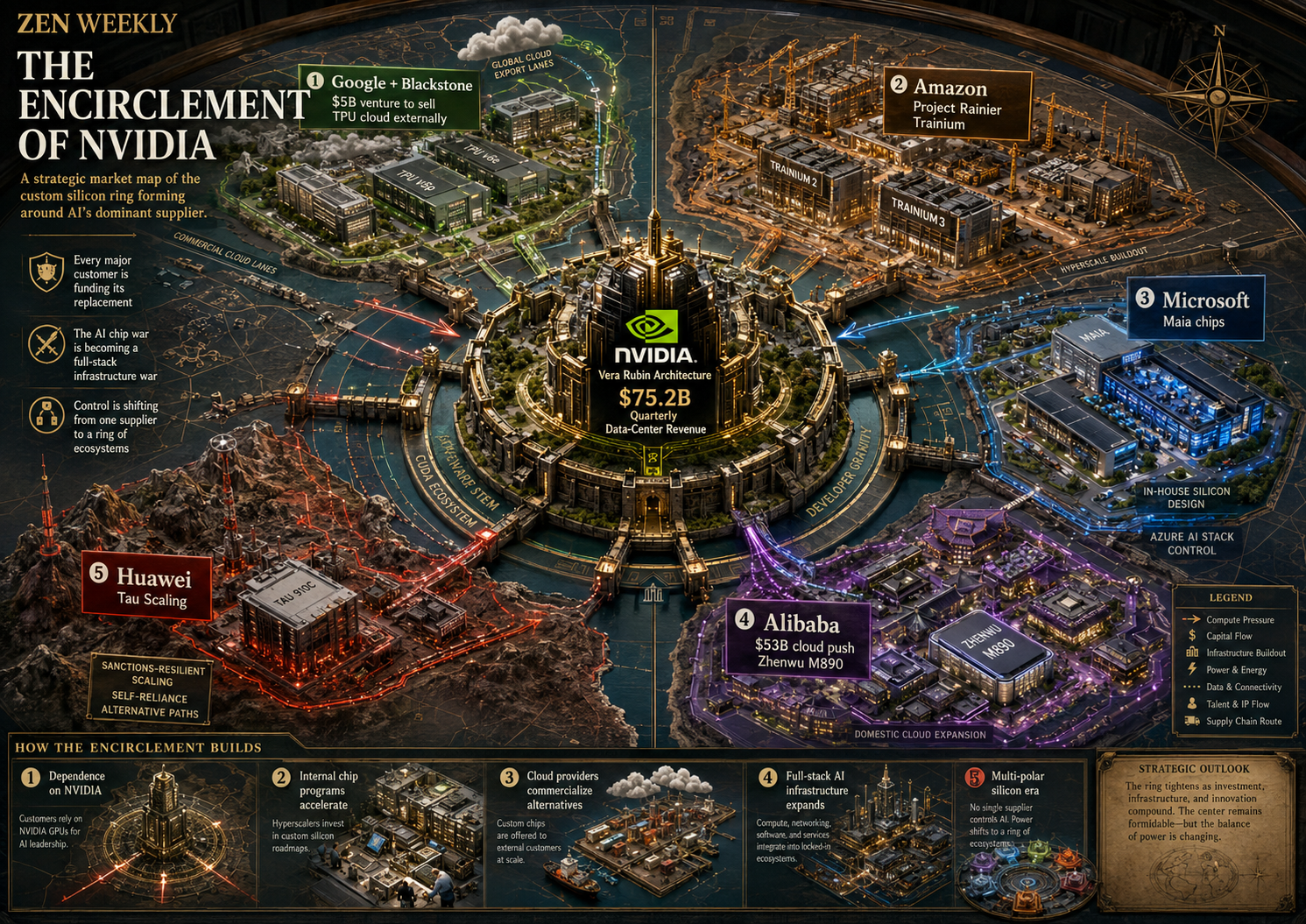
What makes Google especially dangerous now is that it can fight on three fronts simultaneously. It still has DeepMind and a genuine frontier-model program. It has consumer distribution embedded into Search and Android-scale surfaces. And it has custom silicon. On May 19, Google and Blackstone officially announced a new TPU cloud venture, with Blackstone committing an initial $5 billion in equity to bring 500 MW online in 2027 and Google supplying TPUs, software, and services. This is not just a financing story. It is Google taking a hardware advantage that was once mostly internal and turning it into an external market weapon.
That move lands directly on NVIDIA’s turf. NVIDIA remains the immediate financial winner of the boom: on May 20 it reported record quarterly revenue of $81.6 billion and data-center revenue of $75.2 billion, while Jensen Huang said the buildout of AI factories is “the largest infrastructure expansion in human history.” NVIDIA also used GTC 2026 to position Vera Rubin as the platform for the “next frontier of agentic AI,” not just as another GPU generation. The company is plainly trying to climb from chip supplier to full-stack architect of AI factories before customers can route around it.
But the encirclement is real. Amazon has Project Rainier and Trainium. Microsoft has Maia and is reportedly courting Anthropic. Google is commercializing TPU capacity outside its own cloud. Reuters reported on April 1 that Chinese GPU and AI-chip makers captured nearly 41% of China’s AI accelerator server market in 2025. Five days ago, Reuters reported that Alibaba had launched its Zhenwu M890 chip, built for demanding agent workloads, as part of a $53 billion AI-and-cloud push. And today Reuters reported that Huawei had unveiled “Tau Scaling” and a LogicFolding architecture as a path to higher-end chips under sanctions. None of these alone dethrones NVIDIA. Together, they end the assumption that the whole market must remain permanently NVIDIA-shaped.
Coding became the first real money war
!!
The fastest way to understand why the AI landscape feels different now is to look at coding. The first big surprise of the application layer was that users would pay not merely for smarter autocomplete, but for systems that could plan, edit across files, run tests, manage context, and act like junior-to-midlevel collaborators. Reuters reported last year that most AI coding startups were relying on Anthropic’s Claude model, and that those code-generation companies had become meaningful drivers of Anthropic’s revenue. Cursor, more than any other company, proved that a focused product sitting on top of someone else’s frontier model could capture enormous user love and enterprise willingness to pay.
The labs have spent the last year internalizing that lesson. Anthropic’s language around Claude Code now centers on an “agentic coding system” that reads a codebase, makes changes across files, runs tests, and delivers committed code. OpenAI has rebuilt Codex into what it calls a command center for multi-agent workflows. Google has refashioned Antigravity into an “agent-first development platform,” with managed agents powered by the Antigravity harness. This is why the model-launch cadence still matters, but matters differently: the flagship model is now fuel for higher-order software systems that users actually run all day.
This is also where the most unusual strategic deals are happening. Reuters reported last month that SpaceX secured an option either to acquire Cursor for $60 billion later this year or to pay $10 billion for a strategic partnership. That move makes much more sense if you stop thinking of coding tools as mere wrappers and start thinking of them as the first durable operating systems for AI-native work. If OpenAI wants Codex to be that OS, Anthropic wants Claude Code to be that OS, and Google wants Antigravity to be that OS, then buying or locking up the leading independent coding surface is perfectly rational.
The surrounding moves reinforce that reading. Anthropic doubled Claude Code’s usage limits immediately after the SpaceX compute announcement. OpenAI says more than 4 million people use Codex weekly. Reuters reported that Microsoft had considered acquiring Cursor, but backed away over antitrust concerns, and separately reported that Microsoft is eyeing deals for “life after OpenAI.” These are not isolated signals. They show that the most important application layer in AI is being contested by nearly every serious power center in the industry at once.
Meta sits here as a cautionary example. It is still powerful and still capable of surprising the market, but recent Reuters reporting shows the limits of brute-force AI catch-up. Reuters reported in April that Meta would begin capturing U.S.-based employees’ mouse movements, clicks, keystrokes, and screen snapshots to create training data for internal agent work, and Reuters and other reporting this month described large layoffs and broad staff reassignments to support Meta’s AI push. The pattern is revealing: big spending, talent raids, and data capture can help, but they do not instantly produce the application fit that Cursor, Claude Code, and Codex already found in the wild.
After harnesses come standards, payments, and trust layers
One of the quietest but most revealing developments of the last six months is that the fiercest competitors in AI are now cooperating on some of the protocols beneath it. On December 9, 2025, the Linux Foundation announced the formation of the Agentic AI Foundation, anchored by Anthropic’s Model Context Protocol, Block’s goose, and OpenAI’s AGENTS.md. OpenAI said it was co-founding the foundation alongside Anthropic and Block, with support from Google, Microsoft, AWS, Bloomberg, and Cloudflare. Anthropic said the same day that it was donating MCP into that neutral structure. Rival labs do not do this unless they think the next bottleneck is interoperability.
That is the clearest sign yet that the race has moved beyond raw model IQ. OpenAI’s Codex materials talk about the harness. Anthropic’s engineering posts talk about effective harnesses for long-running agents and about managed agents that decouple “the brain from the body.” Google says managed agents in the Gemini API are powered by the Antigravity harness. When all three of the major labs converge on that vocabulary, it means the market has discovered a new truth: once models become good enough, advantage starts to come from orchestration, persistence, context engineering, tool protocols, approval flows, and the ability to embed intelligence into real systems.
The next layer after that is payments. On April 2, the Linux Foundation launched the x402 Foundation as the neutral home for Coinbase’s x402 protocol. The foundation’s announcement described x402 as an open standard that embeds payments directly into web interactions so APIs, apps, and AI agents can transact over HTTP. Two weeks ago, AWS announced Bedrock AgentCore Payments built with Coinbase and Stripe, explicitly describing how an agent can encounter an HTTP 402 response, negotiate payment via x402, and continue its reasoning loop without human checkout interruption. Cloudflare’s agentic-payments documentation describes the same shift. The importance of this is hard to overstate: once agents do work, they need ways to buy tool access, data, and services autonomously.
This is also where some of the more niche-seeming Web3 and trust conversations start to matter again. NVIDIA put NEAR cofounder Illia Polosukhin on its 2024 GTC panel with the other authors of “Attention Is All You Need.” NVIDIA’s 2025 on-demand GTC session featured him presenting on confidential and verifiable AI computing. And NVIDIA’s 2026 catalog includes an Illia session on “Market Primitives for an Agentic Economy.” That does not prove decentralized AI is about to dominate. It does show that questions of verifiability, privacy, user ownership, and machine-to-machine market design have moved close enough to the center of the stack that NVIDIA is giving them stage time, not just the crypto world.
Where power is moving now
OpenAI still looks strongest on mass distribution, consumer habit formation, and turning its models into a broad work platform. Anthropic looks strongest on enterprise credibility, coding, and diversified compute sourcing. Google looks strongest on the blend of consumer distribution, custom silicon, and deep integration into search and everyday workflows. NVIDIA remains the immediate toll collector. Musk’s empire looks less like a pure model competitor and more like an emerging broker of compute, capital, and application-layer optionality. Microsoft, Amazon, Blackstone, Broadcom, CoreWeave, and SpaceX are not supporting characters anymore; they are power centers in their own right because the decisive resource is no longer only intelligence but industrial-scale, financeable, routable access to intelligence.
The deepest change is conceptual. In 2022 and 2023, the key question was who had the best frontier model. In 2026, the key question is who can own the stack that makes frontier models matter: the chips, the clusters, the cloud contracts, the harnesses, the coding surfaces, the enterprise workflows, the interoperability standards, and the payment rails. The winner of that war may or may not also be the company with the single best model on benchmark day. The companies acting like they understand that are the ones making the most coherent moves right now.
Open questions and limitations
Some of the most eye-catching compute numbers in this market are not directly comparable. Gigawatts, chip counts, reserved capacity, cloud-spend commitments, “planned” sites, and “online” deployments refer to different things. Anthropic’s 5 GW AWS commitment, OpenAI’s nearly 7 GW planned Stargate footprint, SpaceX’s monthly contract value, and Google’s future TPU cloud all operate on different timelines and accounting grounds, so any direct leaderboard should be treated cautiously.
A second limitation is that some of the freshest financial details—especially around SpaceX’s IPO filing, Anthropic’s projected profitability, and various private-company valuation discussions—come from Reuters and other reporting on filings and sources rather than from full public-company disclosure sets. They are still highly relevant, but they are lower-confidence than finalized audited statements. And on the specific question of Musk having an Anthropic equity stake, the public material available to me through May 25, 2026 supports a compute-partnership interpretation, not an ownership one.