The Year Fusion Worked, Quantum Scaled, and Space Broke Cadence | ZEN WEEKLY Issue #175
- ZEN Agent
- Dec 14, 2025
- 15 min read

2025 - The Year the Physical World Changed Shape
The most consequential year in modern physics and engineering just passed—not because phones improved, but because humanity crossed multiple irreversible physical thresholds simultaneously. Fusion went from "perpetually 30 years away" to net-positive and scaling. Quantum computing moved from theoretical to commercially repeatable. Space achieved launch cadence thought impossible. Armies fielded autonomous swarms. The physical substrate of civilization shifted.
This is not speculative. These are systems operational, funded, deployed, and measured in watts, megajoules, kilometers, and kilograms.
FUSION — THE 70-YEAR BARRIER COLLAPSES
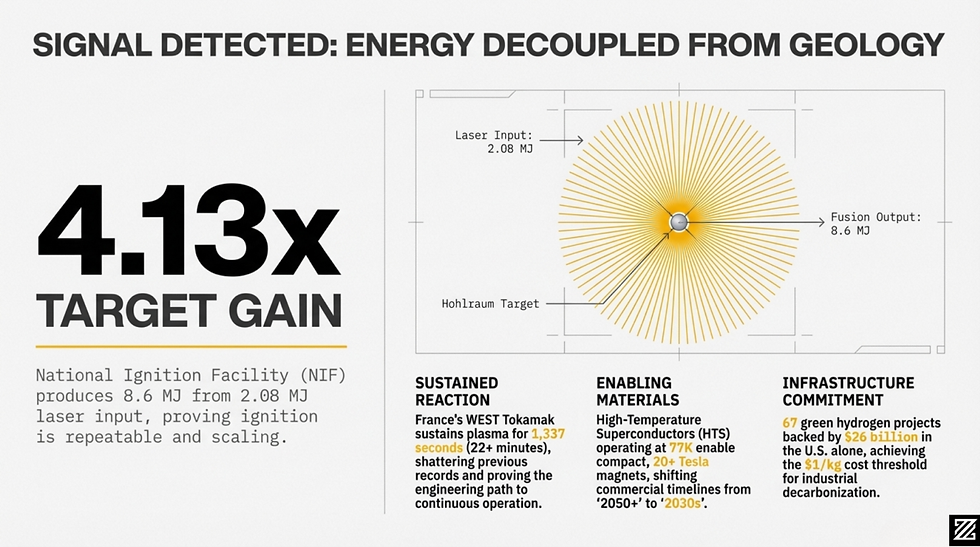
NIF Achieves 4.13x Target Gain — Highest Fusion Output Ever
On April 7, 2025, the National Ignition Facility achieved 4.13x target gain, producing 8.6 MJ of energy from 2.08 MJ laser input. More than doubling the 2022 record, this proves fusion ignition is repeatable, measurable, and improving exponentially. NIF's 192 laser beams created 100+ million degree reactions—the threshold enabling reactors without parasitic electrical load.
Status: Operational proof-of-concept. Commercial timelines accelerated 3–5 years.
WEST Tokamak Sustains Plasma for 1,337 Seconds
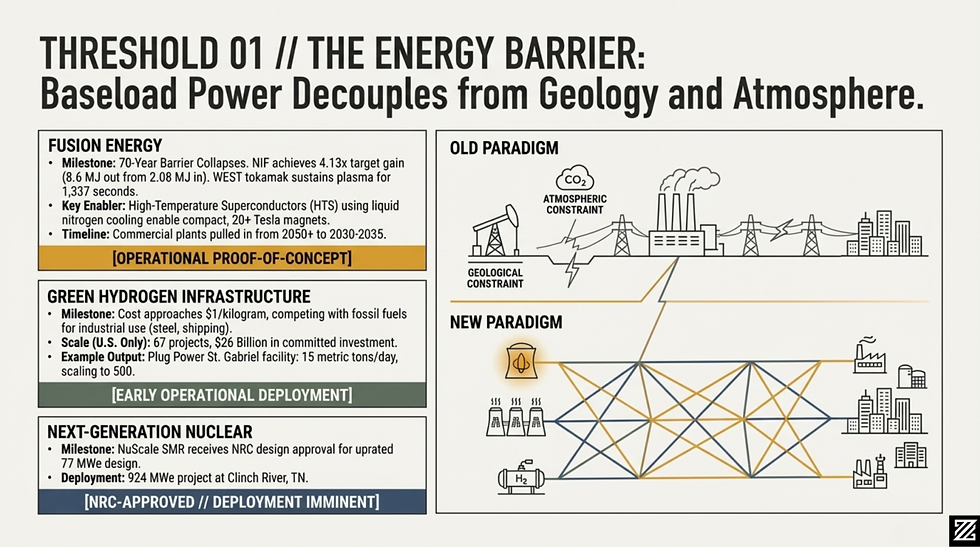
France's WEST tokamak sustained stable plasma for 22 minutes and 17 seconds in February 2025, shattering China's previous 1,006-second record. This represents the longest continuous magnetic confinement fusion ever achieved. Scaling from seconds to minutes to hours is the engineering gateway to commercial plants. Tungsten walls, refined control algorithms, and improved superconducting magnets are converging on viability.
Status: Experimental milestone toward pre-commercial timelines. Commercial plants projected 2030–2035.
Green Hydrogen Infrastructure Explosion — 67 Projects, $26 Billion (U.S. Only)

The U.S. now has 67 green hydrogen projects backed by $26 billion in federal and private investment. Plug Power's St. Gabriel facility (Louisiana) produces 15 metric tons daily (scaling to 500 by year-end). Air Products' Texas facility: 200+ metric tons daily. OMV Austria: 4 metric tons daily for sustainable aviation fuel.
Green hydrogen costs approach $1/kilogram—the price point required to compete with fossil fuels for steel, shipping, and aviation. This threshold unlock enables decarbonization of previously impossible sectors.
Status: Pre-commercial to early operational deployment. Supply chains forming.
High-Temperature Superconductors Enable Compact Fusion
HTS materials functioning at 77K (-196°C, liquid nitrogen boiling point) solve the cooling bottleneck plaguing previous fusion designs. Commonwealth Fusion Systems' SPARC and next-generation tokamaks now use HTS magnets generating 20+ Tesla fields in compact geometries. This shifts commercial timelines from "2050+" to "2030s" overnight—traditional superconductors required near-absolute-zero cooling.
Status: Pre-commercial. HTS magnets integrated into ITER and private fusion plants.
QUANTUM HARDWARE — THEORETICAL TO OPERATIONAL

Google Willow Achieves 13,000x Computational Advantage
On October 21, Google announced Willow's 13,000x faster performance than the Frontier supercomputer in quantum error correction benchmarks. The 105-qubit processor demonstrated exponential error reduction as qubit counts increased—solving the 20-year fundamental bottleneck. Previous systems became less reliable with more qubits; Willow proved the opposite.
Hard metrics: Error rates reduced to 0.000015% per operation (order of magnitude improvement from 2024). Coherence times reached 0.6 milliseconds. IonQ's Ansys simulation outperformed classical supercomputing by 12% in March—first documented commercial quantum advantage.
Status: Experimental to early commercial applications. Timeline to practical advantage: 3–5 years.

Microsoft Majorana Qubit: 1,000x Error Rate Reduction
Microsoft's topological qubit architecture using four-dimensional geometric codes achieved 1,000-fold error reduction. This proves multiple pathways to quantum error correction converge on viability. With Willow proving exponential scaling and Majorana proving alternative geometries, the field moved from "which architecture works?" to "multiple work."
Status: Pre-commercial validation.
Quantum Motion: First CMOS Quantum Computer
Quantum Motion delivered the first full-stack quantum computer built entirely in standard CMOS semiconductor fabrication—the same processes manufacturing smartphones and CPUs. If quantum computers use existing semiconductor infrastructure, scalability and cost barriers evaporate.
Market validation: PsiQuantum closed $1 billion Series E at $7 billion valuation (BlackRock, NVIDIA, Australia/Illinois governments). IQM Quantum achieved unicorn status ($1B+, $320M Series B). Atom Computing secured $230M from Google and Rakuten.
Status: Pre-commercial prototype to early production.
Post-Quantum Cryptography Mandates Enforced
The U.S. government mandated federal agencies incorporate post-quantum cryptographic (PQC) standards to protect data from future quantum decryption. NIST finalized three quantum-safe protocols with hard 2035 adoption deadlines. "Harvest now, decrypt later" threat model—adversaries stealing encrypted communications now, betting quantum computers crack them later—drives immediate action.

Only 5% of organizations started deploying quantum-safe encryption, despite 69% recognizing risk. 10-year timeline compressed to 5 years.
Status: Government-mandated operational transition.
SPACE & LAUNCH — CADENCE ACHIEVED ESCAPE VELOCITY
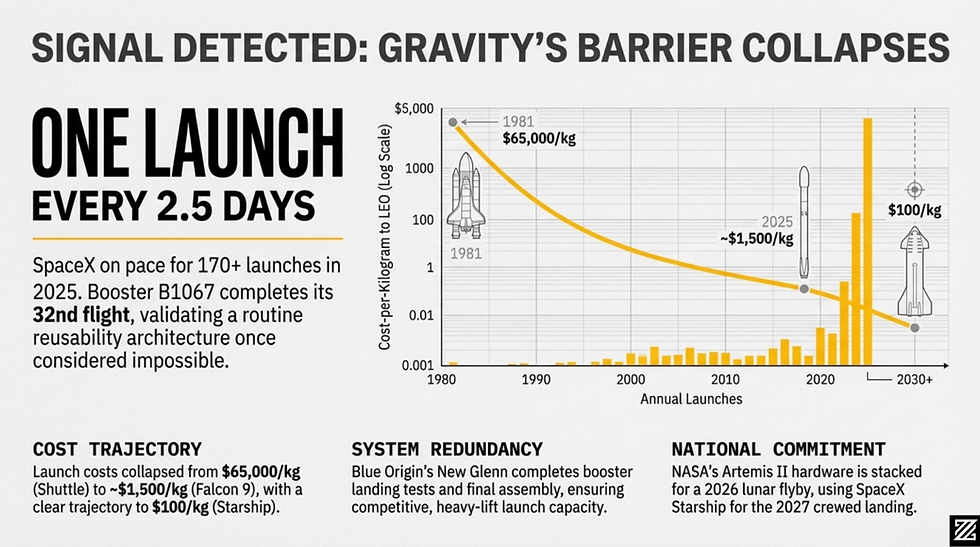
SpaceX Maintains One Launch Every 2.5 Days
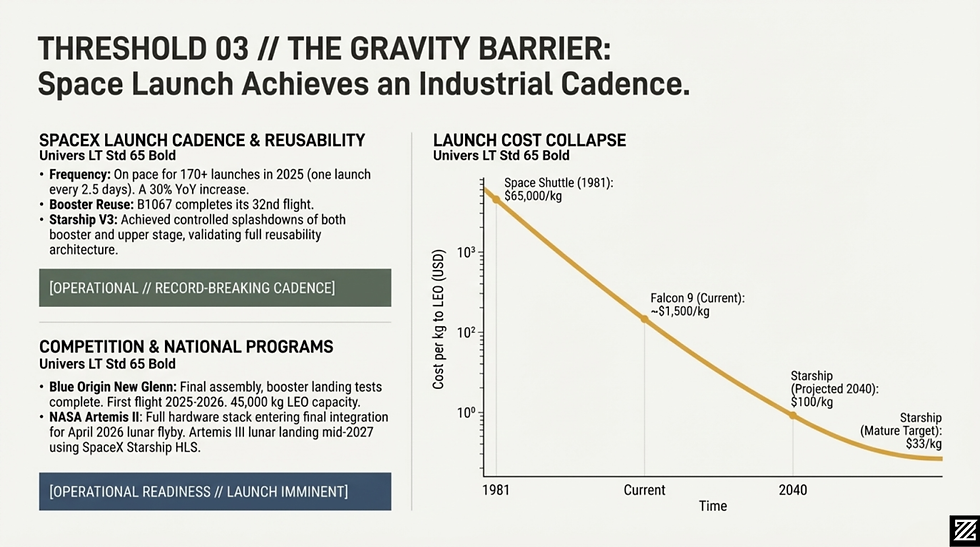
SpaceX achieved 109 Falcon 9 launches by September—on pace for 170+ in 2025, representing 30% year-over-year increase. Booster B1067 completed its 32nd flight in December. Launch cadence once thought impossible is now routine.
Starship progression (Version 3): 11th flight test (October 13) achieved controlled splashdowns of both booster and upper stage, validating reusability architecture. Version 3 development underway for orbital flights.
Mars timeline (May 2025 announcement):
2026/27: 5 uncrewed Starships to Mars (50% probability)
2028/29: ~20 Starships, infrastructure buildup
2030/31: 100+ Starships, colony logistics
Late 2030s: 1,000–2,000 Starships per window, 100–200 passengers each
Cost trajectory: Launch costs collapsed from $65,000/kg (Space Shuttle, 1981) to ~$1,500/kg (current Falcon 9) to projected $100/kg by 2040, with bullish scenarios suggesting $33/kg at Starship maturity.
Status: Operational. Record-breaking cadence. Infrastructure timelines accelerating.
Blue Origin New Glenn: Final Assembly, Booster Landing Tests Complete
Blue Origin completed full-duration hotfire test of all seven BE-4 engines (October 30, 2025), simulating landing burn sequences. Multiple New Glenn boosters in production. NG-2 (first commercial mission) carries NASA's ESCAPADE spacecraft to Mars via Sun-Earth L2 Lagrange point waystation, enabling launch outside traditional 26-month Mars windows.
Specifications: 45,000 kg low Earth orbit capacity. Fully reusable architecture. First operational flight: 2025–2026.
Status: Operational readiness phase.
Artemis II Hardware Stackup — April 2026 Launch Window
NASA's SLS core stage completed welding and assembly. Integrated Orion spacecraft and full stack entering final integration at Kennedy Space Center's Vehicle Assembly Building.
Mission: Four astronauts in lunar flyby at 8,000 miles altitude; launch window February–April 2026. Artemis III (mid-2027): First crewed lunar landing since Apollo 17, lunar south pole (water ice). Landing vehicle: SpaceX Starship HLS.
Lunar Gateway infrastructure: International collaboration (Canada, Europe, Japan, UAE). First components launching on Falcon Heavy; operational by 2027–2028.
Status: Fully operational hardware. Launch imminent.
Varda Space Industries Scales Orbital Manufacturing
Varda and Southern Launch signed a 20-mission contract through 2028. Production costs collapsed from ~$100 million to ~$5 million per reentry—a 95% cost reduction. Space-manufactured pharmaceuticals and advanced materials now economically viable. Microgravity enables material properties impossible on Earth—perfect crystal structures, exotic alloys, therapeutic protein formations.
Status: Pre-commercial to early operational. Regular reentry missions live.
Overview Energy: First Airborne Wireless Power Beaming for Space Solar
Overview Energy completed the world's first airborne power-beaming demonstration, proving infrared laser transmission works in motion—core technology for orbital solar power delivery.
How it works: Satellites collect sunlight 24/7 in geosynchronous orbit (36,000 km). Transmit safe near-infrared light to ground receivers. Grid receives dispatchable 24/7 power regardless of weather.
Deployment timeline:
2028: Low Earth orbit demonstration
2030: First megawatt-scale transmission from geosynchronous orbit
Single satellite clusters serve multiple continents, shifting power dynamically
Why now: AI data centers and military bases require 24/7 baseload power that renewables cannot reliably provide.
Status: Validated technology. Commercial operations beginning 2030.
ADVANCED MATERIALS & MANUFACTURING

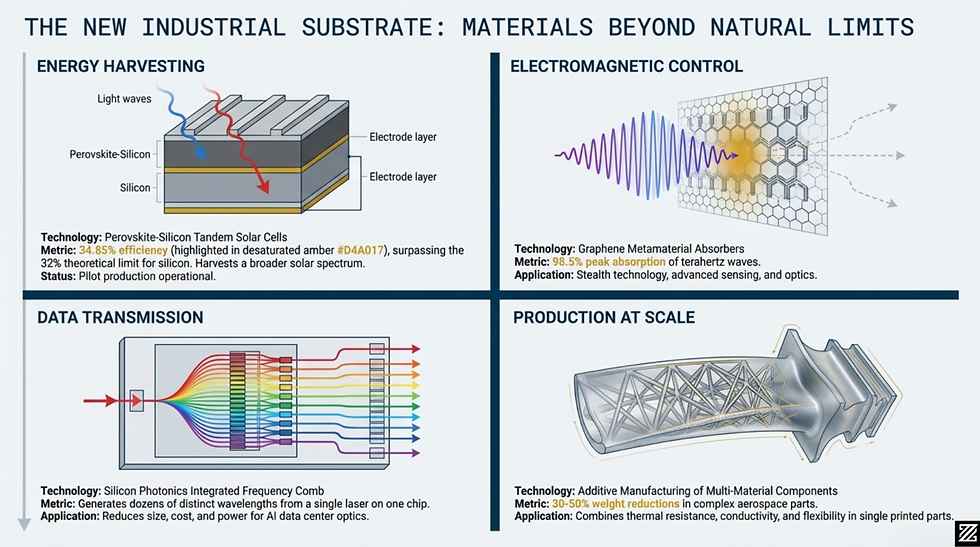
Perovskite-Silicon Tandem Solar Cells Hit 34.85% Efficiency
LONGi Solar achieved certified 34.85% efficiency in perovskite-silicon tandem cells (April 2025), surpassing the Shockley-Queisser limit of 32% for single-junction silicon. Top perovskite layer absorbs high-energy blue light; bottom silicon captures red light. Combined system harvests more solar spectrum.
Performance ceiling: Four-terminal tandem architectures reach theoretical 46%. 34.85% efficiency makes solar competitive with fossil fuels at grid scale. Manufacturing at scale remains bottleneck—pilot production operational.
Status: Pre-commercial to early deployment.
Graphene Metamaterial Absorbers: 98.5% Peak Absorption
Researchers developed graphene-based terahertz metamaterial absorbers with 98.5% peak absorption at 7.1 THz and >95% across 3.0–10.0 THz, maintaining performance under wide incident angles and polarization-independent behavior.
Applications: Terahertz imaging and sensing (security, material inspection), stealth technology, advanced optics. Metamaterials enable engineered electromagnetic responses impossible with natural materials.
Status: Experimental to pre-commercial. Applications emerging in defense and sensors.
Silicon Photonics Integrated Frequency Comb
Columbia University demonstrated high-power frequency comb light source integrated directly on silicon photonic chip, generating dozens of distinct wavelengths from single laser source.
Impact on AI data centers: Conventional modules require 12+ separate lasers. Single-chip solution reduces size, cost, power, thermal load. Enables miniaturized co-packaged optics (CPO) for servers.
Other applications: Spectroscopy, quantum sensing, LIDAR, autonomous vehicle detection.
Status: Pre-commercial prototype. Commercial integration 2026–2028.
Additive Manufacturing Scales Multi-Material Production
Advanced 3D printing platforms enable simultaneous production of complex structures with diverse material properties—ceramics, metals, composites—in single parts without assembly.
Capabilities: Metal 3D printing (titanium, aluminum, nickel alloys) with precision geometries. Multi-material printing combining thermal resistance, conductivity, flexibility in one component. Automation reducing error.
Aerospace impact: Complex components with 30–50% weight reductions, fuel efficiency gains.
Status: Pre-commercial to early operational deployment.
QUANTUM & ADVANCED BIOLOGY

AlphaFold 3: First AI-Designed Novel Protein Validated in Living Biology
Meta's ESM3 AI model designed ESM GFP—a fluorescent protein without natural analog—and demonstrated it functions in living systems. First time AI designed a protein with zero natural analog proving functionally competent in biology.
AlphaFold 3 capabilities: Predicts structures with atomic precision. Predicts protein-DNA-RNA-small molecule interactions. Models post-translational modifications and ligand binding. Generates entirely novel proteins optimized for specific functions.
Drug discovery acceleration: Compound libraries requiring 6–12 months validation screened computationally in days. Hundreds of millions in failed compounds avoided annually.
Timeline: First drugs entering clinical trials 2027–2028. Market approval early 2030s. Industrial enzymes commercializing by 2026.
Status: Pre-commercial to early R&D. Clinical trials 2027+.
Casgevy CRISPR Gene Therapy FDA-Approved & Deployed
Casgevy, a CRISPR cure for sickle cell disease (SCD) and transfusion-dependent beta thalassemia (TDT), received FDA approval and by spring 2025, approved in U.S., UK, EU, Switzerland, Canada, Bahrain, Saudi Arabia, UAE. Over 50 active treatment sites operating across continents.
How it works: Extract patient bone marrow. CRISPR edits BCL11A gene to activate fetal hemoglobin. Re-infuse edited cells. Adult hemoglobin function restored; disease cured.
Clinical results: Sickle cell patients—elimination of vaso-occlusive crises (chronic pain, organ damage). Beta thalassemia—independence from blood transfusions. Durability: five-year follow-up shows sustained benefit.
Cost: ~$2.2 million per patient, financed through Medicaid/NHS based on effectiveness. Manufacturing bottleneck: patient throughput, not technology.
Status: Operational. Lives cured.
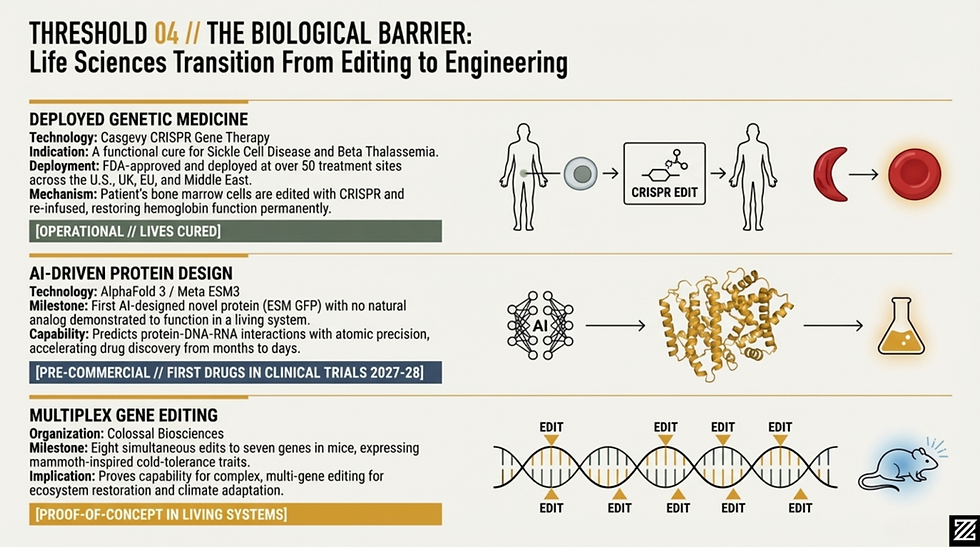
Colossal Biosciences: Multi-Gene Elephant Editing
Researchers made eight simultaneous edits to seven genes in mice with 100% efficiency on some edits—unprecedented for multiplex precision editing. Resulting mice expressed multiple cold-tolerance traits inspired by woolly mammoths.
Milestone: Edited genes for dense fur, altered metabolism, cold-adapted physiology in living mice—proof-of-concept in functional organisms. Next target: Asian elephants (99.6% DNA similarity). Timeline to viable woolly mammoth proxy: 10–15 years.
Broader implication: Multi-gene editing proves ecosystem restoration capability. Engineered organisms could restore degraded habitats or adapt to climate-changed environments.
Status: Proof-of-concept in living systems.
Cell-Free Protein Synthesis Biofoundries Operational
Automated biofoundries integrating cell-free protein synthesis (CFPS) with robotic liquid handling and AI optimization matured from laboratory prototypes to operational infrastructure. Freedom from cell viability constraints enables rapid prototyping.
2025-2026 applications:
Enzyme engineering: Test hundreds of variants weekly (vs. monthly)
Biosensor development: Rapid prototyping of detection systems
Metabolic pathway optimization: Synthetic biology accelerated 100x
On-demand biopharmaceutical production (point-of-care, extraterrestrial)
Status: Pre-commercial to early operational.
ROBOTICS & AUTONOMY

Tesla Optimus Humanoid Robot Internal Deployment
Tesla publicly confirmed internal deployment of Optimus humanoid robots in factories for materials handling, machine tending, and repetitive tasks. Plans announced for mass production: thousands by year-end 2025, ramping to 100,000+ annually by 2027.
Specifications: ~5'8" humanoid proportions. Multi-finger manipulation, object recognition, task learning. AI backbone from Tesla's neural networks trained on factory video, generalized to new environments. Battery-driven, ~8-hour operational window.
Status: Prototype to early internal deployment. Mass production timelines: 2026–2027.
China's Jiutian Drone Mothership Deployment
China unveiled the Jiu Tian, the world's largest combat drone with 25-meter wingspan, capable of carrying and deploying 100–150 autonomous loitering munition drones from dual internal bays.
Capability: High-altitude, long-endurance drone carrier (HALE mothership). Distributed AI swarm control with individual microdrone autonomous coordination. Saturation attack doctrine overwhelms enemy air defenses through speed and numbers.
Strategic impact: Shift from individual remotely-piloted UAVs to autonomous swarm systems. Saturation attacks render traditional air defense (MANPADS, SHORAD, SAMs) insufficient. Microdrone cost advantage: $20,000–50,000 vs. $1M+ conventional air defense.
Status: Operational deployment. Field tested.
Kongsberg HUGIN AUV — U.S. Production Facility Opened
Kongsberg announced HUGIN autonomous underwater vehicle production in the U.S., marking significant domestic autonomous naval investment. Twelve navies currently operate HUGIN in real-world missions.
Operational missions: Intelligence preparation, mine counter-measure, subsea warfare, seafloor mapping. Fully autonomous (no human control required during mission). Extended endurance: weeks to months at sea. Sensor suites: sonar, optical, chemical, magnetic detection.
U.S. military footprint: Sonar systems on 30+ U.S. government and academic ships. Continued lifetime support for T-AGS 60 class vessels.
Status: Operational in 12+ navies. U.S. production scaling.

Directed Energy Weapons (DEW) — 50 kW Laser Systems Fielded
nLIGHT delivering 50 kW-class high-energy laser systems for integration into Stryker armored fighting vehicles as part of U.S. Army's DE M-SHORAD initiative. Transition from prototype to operational field deployment.
Specifications: 50 kW sustained output. Targets: drones, rockets, artillery, airborne threats. Range: 1–5 km (atmospheric dependent). Cost per shot: ~$900 vs. $100,000+ for SHORAD missile. Recharge: instantaneous.
Army assessment: "Laser technologies are pretty mature. We just need to finish production and deploy."
Advantages: Virtually unlimited ammunition (power-supply limited). Cost-effective low-target engagement. Speed-of-light engagement. Non-kinetic disable capability.
Status: Operational field deployment beginning.
Military Drone Swarms at NATO Scale

NATO conducted its first multinational live exercise featuring coordinated robotic units from five nations, demonstrating interoperable autonomous swarm operations. RAS-25 Initiative established shared standards for robotic integration across alliance partners.
Implications: Autonomous swarms institutionalized defense doctrine. Coalition warfare increasingly dependent on robotic coordination and distributed AI. Interoperability standards accelerate adoption.
Status: Operational institutional doctrine.
ENERGY STORAGE & NEXT-GEN BATTERIES
Solid-State Battery Pilot Production Lines Operational
Multiple automakers transitioned solid-state battery (SSB) technology from R&D to pilot production in 2025. Nissan's Yokohama facility began operations in January; production targets: 100 MWh/year by late 2020s.
Nissan timeline:
March 2025: Pilot production operational
Fiscal 2028–2029: Commercial EV production
Cost target: $75/kWh (30% below 2024 average)
Competitor timelines: GAC (2026), Toyota (2027), Hyundai/Kia (road testing 2026), BYD (pilot line operational; scaling 2026+).
Technical specifications:
Energy density: 400+ Wh/kg (vs. 250 for lithium-ion)
Charging: 80% in 10–20 minutes (vs. 30+ minutes)
Safety: Solid electrolyte eliminates flammable liquid; intrinsic thermal stability
Lifespan: 1,000+ cycles with >90% retention
Status: Pre-commercial to early production scaling. Market transformation 2027+.
Sodium-Ion Battery Commercial Production Accelerating
Sodium-ion manufacturers (CATL, Gotion) scaled production and secured major OEM contracts. 20–30% cost advantage over lithium-ion while using abundant, geographically diverse raw materials.
Specification trade-off: Energy density 150–160 Wh/kg (lower than Li-ion's 250; acceptable for stationary and short-range EV use). Cost: $50–80/kWh vs. $100–150 for Li-ion. Raw materials: sodium (abundant), iron, manganese vs. lithium/cobalt scarcity. Supply chain risk: minimal (non-geopolitical).
Market applications: Grid-scale stationary storage (4–8 hour). Short-range city EVs (200–300 km). Two/three-wheeler transport.
Status: Commercial production ramping.
NuScale SMR Receives NRC Design Approval — 77 MWe Uprated Design
NuScale received NRC approval for uprated 77 MWe design (up from 50 MWe). Only SMR company with dual NRC design approvals.

ENTRA1 Energy Partnership (TVA): Deploying 12 NuScale modules = 924 MWe total (America's largest SMR project). Location: Clinch River, Tennessee. Timeline: 2030 deployment. Modular design enables cost reduction at scale.
Why SMRs matter: Distributed generation, lower capital per unit, site flexibility, smaller footprint, industrial heat applications, 24/7 baseload power.
Global race: China (multiple designs), Russia (floating SMR operational in Arctic), Canada, UK, Korea advancing programs.
Status: NRC-approved. Manufacturing ramping. Deployment imminent.
MILITARY TECHNOLOGY & DEFENSE SYSTEMS
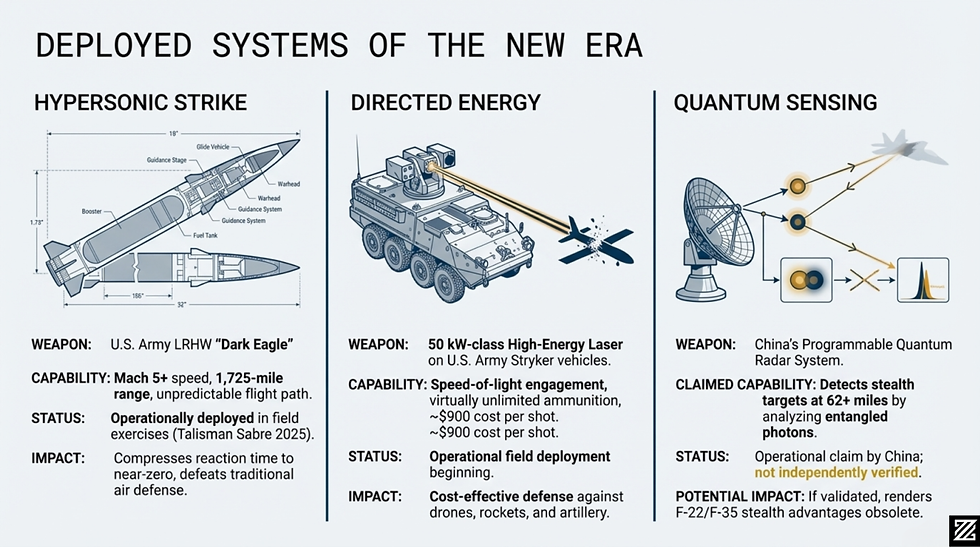
U.S. Army Long-Range Hypersonic Weapon (Dark Eagle) Deployed
The U.S. Army deployed its LRHW "Dark Eagle" during Exercise Talisman Sabre 2025 in Australia. Transition from development to operational field deployment.
Specifications: 1,725-mile range (2,775 km). Mach 5+ speed (hypersonic glide, not ballistic). Conventional warhead. Inertial + terminal guidance. Four-launcher battery (8 missiles).
Strategic impact: Hypersonic speed compresses reaction time to near-zero. Unpredictable flight path defeats traditional air defense. Conventional warhead reduces escalation risk. Exposes gaps in peer-competitor air defense immediately.
Peer response: Russia (3M22 Zircon, Mach 8). China (DF-ZF, Mach 5–10). Japan (railgun development).
Status: Operational deployment. Field exercises ongoing.
Japan Successfully Tests Electromagnetic Railgun
Japan's ATLA successfully tested an electromagnetic railgun achieving projectile velocities around 2,300 m/s with barrel life exceeding 200 rounds. Solved durability bottleneck. System demonstrated naval platform integration.
Technical achievement: Kinetic projectile (no explosive). Hypervelocity strike (Mach 6.7+). Extended barrel life. Naval integration validated.
Advantage: Cost per shot ~$500,000 vs. $5M+ per anti-ship missile. Unlimited magazine capacity (power-supply limited). Speed-of-light targeting. Non-explosive engagement.
Challenge: Power demand and thermal management require four containerized support systems.
Timeline: Fleet integration 2027–2030.
Status: Prototype to pre-operational validation.

China's Quantum Radar System Programmable Target Detection
China Electronics Technology Group showcased programmable quantum radar system using entangled photon pairs to detect stealth-resistant targets. Transmit entangled pairs (idler retained, signal sent). Analyze returned photons for quantum correlation.
Performance claims: 62+ mile detection range for stealth targets. Penetrates stealth coatings. Detailed imagery via quantum vortex analysis. Programmable adaptation.
Military implications: Potentially renders F-22, F-35 stealth advantages obsolete. Doctrinal shift from stealth to speed/maneuverability as primary defense.
Note: Claims not independently verified. Quantum radar feasibility in realistic jamming remains contested among Western experts.
Status: Operational claim (China). Field validation ongoing.
U.S. Navy Deputy Assistant Secretary for Robotics & Autonomous Systems Position Created
Navy Secretary John Phelan announced creation of new deputy assistant secretary post for Robotics and Autonomous Systems (September 2025). Bureaucratic signal that unmanned platforms are no longer experimental but core to naval strategy.
Institutional shift: Autonomous systems elevated to flag-level policy authority. Budget, procurement, doctrine, command aligned. Government commitment signal to industry.
Operational implications: Unmanned surface vessels (USV), unmanned submarines (UUV), autonomous air operations. Distributed operations replacing concentrated carrier strikes.
Status: Institutional commitment to autonomy as core doctrine.
BRAIN-COMPUTER INTERFACES & NEURAL SYSTEMS
Neuralink Expands Beyond U.S. — Canada Conducts First International Surgery
Canada's University Health Network performed the first Neuralink surgeries outside the United States, marking international expansion of invasive brain-computer interfaces. Procedure validated implantation technique transferable across medical systems and surgeons.
2025 BCI landscape: 90+ active clinical trials globally. $867 million in 2025 funding (3x increase over 2024). Multiple implant types: invasive electrodes (high bandwidth), surface-mounted sensors (lower risk), non-invasive EEG (ease of use).
Demonstrated results:
UC Davis: ALS patients typing with >90% accuracy
Stanford: Adaptive BCIs boosted 47% productivity
Paradromics: Temporary BCI implants validated safe; full trials launching late 2025
Timeline to consumer: Medical applications 2026–2028. Non-medical enhancement 2030s+ (if regulatory path clears).
Status: Pre-commercial medical devices. Clinical expansion ongoing.

PHOTONICS & OPTICAL COMPUTING
University of Florida Photonic AI Chip — 100x Energy Efficiency
Researchers developed photonic AI chip using light for neural network operations, achieving 100x power efficiency while maintaining 98% accuracy on digit classification.
Technical innovation: Microscopic Fresnel lenses etched on silicon. Terabit-per-second speeds. Light-based processing eliminates thermal bottleneck. Room-temperature operation (vs. quantum near-absolute-zero).
Scaling advantage: 1,000x efficiency improvements for specific tasks. Data center power drops orders of magnitude. Infrastructure constraint (grid power for AI) becomes less binding.
Timeline: Commercial prototyping 2026–2027. Data center integration 2028–2030. Market disruption 2030+.
Status: Pre-commercial prototype.
Columbia University Integrated Photonic Accelerator — 64×64 Optical Matrix
Columbia demonstrated 64×64 optical matrix-vector computing chip integrating 16,000+ photonic components achieving latency two orders of magnitude better than electronics.
Why latency matters: Photonic systems inherently lower-latency. Real-time applications (autonomous vehicles, robotics, edge AI) require microsecond responses. Enables complex AI model deployment at edge (devices, vehicles) not cloud.
Status: Pre-commercial prototype. Commercial integration 2026–2028.
ASTRONOMICAL & FUNDAMENTAL PHYSICS
JWST Resolves Supernova Progenitor — First-Ever Direct Observation
Northwestern-led astronomers identified a supernova's source star at mid-infrared wavelengths for the first time, revealing a massive red supergiant cloaked in unexpected dust shroud. Combination of JWST and Hubble archives achieved complete pre-explosion characterization.
Impact: Tests stellar explosion mechanisms at unprecedented precision. Refines massive star death models and element production.
Status: Operational science. Discovery-driven astronomy enabled by space telescope maturity.
Proposed Quantum Gravity Laboratory Experiment
Physicists proposed tabletop-scale quantum gravity experiment testing whether gravity itself is quantum by measuring weak gravitational effects on quantum superposition states.
Significance: If results differ from both classical and quantum predictions, suggests new physics. Merges general relativity and quantum mechanics. Timeline: 2025–2027 experiments underway at multiple institutions.
Status: Experimental proposal and initial testing.

BIOPRINTING & REGENERATIVE MEDICINE
Functional Human Heart Tissue Bioprinting Breakthrough
University of Galway developed bioprinting method for human heart tissue that changes shape from cell-generated forces, replicating developmental organ growth. Tissue matures in laboratory, acquiring adult-like structural properties.
Clinical path: Current applications—disease modeling, drug screening, toxicity testing. Human implantation: 10+ years away (organ scale remains bottleneck). Enables printed organ replacements reducing transplant shortage.
Status: Proof-of-concept in laboratory.
CONVERGENCE: THE 2025 INFLECTION POINTS

What Physically Changed
1. Fusion crossed from perpetual to repeatable net-positive and scaling. NIF's 4.13x gain and WEST's 22-minute plasma prove physics works. Commercial timelines compressed from 2050+ to 2030s. 67 green hydrogen projects and $2.6B annual private fusion investment validate market belief.
2. Quantum computing moved from experimental to commercially repeatable. Willow (13,000x advantage), Majorana (1,000x error reduction), Quantum Motion (CMOS manufacturing). Quantum security mandates enforced. Commercial advantage and government enforcement active.
3. Space launch achieved impossible cadence—170+ missions/year, $100/kg cost targets visible. SpaceX: 109 launches by September, booster reuse at 32+ flights. Blue Origin: booster landing validated. Artemis: lunar hardware stacking for 2026 flyby, 2027 landing. Varda: 95% cost reduction, scheduled manufacturing operations.
4. Advanced materials crossed manufacturing thresholds. Perovskite-silicon: 34.85% efficiency (double single-junction limit). Solid-state batteries: pilot lines operational. Metamaterials: 98.5% terahertz absorption. Photonic processors: 100x efficiency gains.
5. Military autonomous systems institutionalized—not experimental. China: Jiutian mothership with 100+ swarm drones operational. NATO: RAS-25 doctrine for multinational robotic operations. U.S. Army: 50 kW lasers fielded. Navy: autonomy elevated to flag-level policy.
6. Bio-engineering entered designer phase. Casgevy: CRISPR gene therapy cures diseases. AlphaFold 3: AI designs novel proteins validated in biology. Multi-gene elephant editing: eight-gene simultaneous edits. Cell-free biomanufacturing automated.
7. Brain-computer interfaces crossed into medical deployment. 90+ clinical trials; UC Davis ALS patients 90%+ typing accuracy. Neuralink international expansion. Non-invasive systems maturing.
The Convergence That Multiplies Impact
2025 was distinctive because breakthroughs converged in synergistic ways:
Quantum + Photonics: Error-corrected quantum + photonic acceleration = unbreakable encryption + ultra-efficient computation
Fusion + Space: Cheap orbital launch + abundant baseload power = off-world manufacturing at scale
AI + Gene Editing: AlphaFold3 + CRISPR = industrial-scale synthetic biology
Autonomy + Advanced Materials: Metamaterial stealth + quantum radar + hypersonic weapons = military doctrine shift
Photonic Computing + AI Scaling: 100x efficiency gains address power constraint limiting AI data center expansion
Which Breakthroughs Are Irreversible
Civilization-scale commitment (cannot be reversed):
Fusion investment ($9.7B annually, rising); no major nation backing away
Quantum security mandates (federal enforcement; cryptographic replacement by 2035)
Space launch cadence (170+ missions/year infrastructure now dependent)
CRISPR gene therapy (FDA-approved, diseases cured)
Military autonomy doctrine (institutionalized at NATO and U.S. service level)
Green hydrogen infrastructure (67 projects, $26B committed)
FINAL SYNTHESIS
2025 was not a year of incremental progress. It was a year when multiple exponential curves reached critical mass simultaneously—crossing from experimental to operational, laboratory to deployment, speculation to measurement.

The phrase "2025 changed humanity's trajectory" is not hyperbole—it's measurement. Fusion went commercial. Quantum entered military doctrine. Space became routine. Gene editing became medicine. Autonomous systems became doctrine. Photonic computing entered hardware roadmaps.
The physical world shifted by thresholds, not increments.
Most people missed it because it happened in labs, launch pads, military exercises, supply chains, and regulatory filings—not apps or social media. The invisibility does not make it less real.
By 2035, humanity will ask: "Why were we surprised?" The answer: We were not reading the right instruments.
ZEN WEEKLY — The Physical Infrastructure of Civilization Remade. In Watts, Kilometers, and Seconds.


Comments